Click to zoom
Blood is more than a biological fluid; it is a life-sustaining tissue that connects science, humanity, and responsibility. Every unit of donated blood carries not only cellular components and therapeutic potential, but also the trust of a donor and the hope of a recipient. In modern healthcare, blood banking stands at the intersection of clinical medicine, laboratory science, public health, ethics, logistics, and governance. It is a discipline that demands precision, compassion, and unwavering commitment to safety.
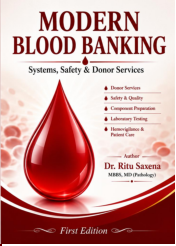
Modern Blood Banking: Systems, Safety & Donor Services has been written with the intent of providing a comprehensive, structured, and practical understanding of contemporary blood transfusion services. Over the past century, blood banking has evolved from empirical and often hazardous transfusion attempts into a highly regulated, evidence-based specialty grounded in immunohematology, molecular diagnostics, quality systems, and patient-centered care. Advances in component therapy, infectious disease screening, hemovigilance, and regulatory frameworks have transformed transfusion medicine into one of the most safety-conscious domains in healthcare.
This book is designed to serve students, laboratory professionals, transfusion medicine specialists, clinicians, hospital administrators, and policymakers who seek clarity and depth in understanding blood banking systems. It begins with historical milestones and foundational principles, progressing through donor management, component preparation, testing methodologies, storage standards, quality assurance, and clinical transfusion practices. Special emphasis has been placed on regulatory compliance, NABH and national guidelines, biosafety, and ethical governance, recognizing that blood is legally and ethically treated as a biological drug requiring strict oversight.
A central theme of this book is the transition from replacement-driven systems to voluntary non-remunerated blood donation, underscoring safety, sustainability, and public trust. Donor services are explored not merely as operational activities but as ethical partnerships between healthcare systems and communities. The book also addresses emerging technologies such as nucleic acid testing, pathogen reduction, molecular typing, digital traceability systems, and future innovations including artificial blood and bioprinted components—areas that will shape the next era of transfusion medicine.
While scientific accuracy and regulatory alignment have guided the content, equal attention has been given to practical applicability. Sample questionnaires, SOP formats, quality control charts, and consent templates have been included to support real-world implementation and accreditation readiness.
I acknowledge with deep appreciation the efforts of Professional Publication Services – A Medical Content Publishers, whose editorial integrity, technical precision, and commitment to medical scholarship have ensured that this work meets the highest professional standards. Their contribution has been instrumental in transforming this manuscript into a comprehensive academic resource.
Blood banking is ultimately a discipline built on accountability. From donor vein to recipient vein, every step must reflect integrity, vigilance, and respect for human life. It is my hope that this book not only strengthens technical knowledge but also reinforces the ethical responsibility inherent in transfusion practice.
~Dr. Ritu Saxena